-
![]()

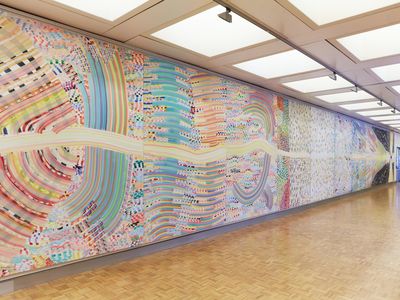
Richard Dunn, The Labyrinth, 2005, acrylic on canvas, 198 x 620 cm, UTS Art Collection gift of Suzanne Davies, 2024 Photo: Richard Glover

Richard Dunn
The Labyrinth
2005
acrylic on canvas
2 parts, 198 x 620 cm overall
Located in the UTS Tower Foyer, CB01.04
The Labyrinth is one of a series of paintings and installations produced by the artist between 2005 and 2011. The labyrinths can be seen as a logical extension of Dunn’s explorations of the grid and systems (of meaning, metaphor, and analysis) through his paintings and installations.
In 2009, as part of the Vivid Sydney Festival / Smart Light Sydney: Art Light at UTS, Richard Dunn constructed perhaps his largest labyrinth, a 3 x 16 m, Labyrinth of Light, from painted plywood and fluorescent lights in the UTS Tower foyer.
The Labyrinth series features a tightly wound maze in a lighter colour floating above a contrasting background – in this case, an interwoven field of bright blocks of colour, divided according to the mathematical sequence known as the Fibonacci Series.
Leonardo Fibonacci (c.1170-1250) was an Italian mathematician credited with introducing Indian mathematics to Europe with this remarkable mathematical sequence that appears throughout nature in tree branches, the whorls of flower heads and shells, and countless other branching organisms and systems. Fittingly, Dunn's Labyrinth series culminated in an extraordinary version created in India in 2010 using the traditional rangoli technique of loose marble dust and pigment laid onto a horizontal plane. (1)
Dunn’s labyrinths are concerned with the relationship between mathematics and the physical world but also draw on deeper cultural connections including his own Celtic heritage.
“In many cultures labyrinths and mazes have a special and sacred meaning: it is a path that reflects the choices that we take in life, a metaphor for the complexity of place and now, as the world becomes predominately urban, our cities.” (2)
Designed with digital precision, The Labyrinth has much in common with an architectural blueprint or a musical score. In painted form, the labyrinth invites a meditative relationship with the abstract image. The eye is drawn to follow each path, turning left or right, meeting dead ends, returning until a way is found back to the outer edge of the canvas. Unlike a true labyrinth that has a single, continuous path encouraging constant forward motion, these mazes have multiple branches, breaks, and folds, reflecting both a state of speculation and meditation.
(1) The Labyrinth at Mati Ghar: following an Artist in Residence program at Sanskriti Kendra, New Delhi in 2010, was made with the assistance of Sanjhi artists from Svrindavan led by Shri Viswajit Das.
(2) Richard Dunn with Jasleen Dhamija, quoted in Richard Dunn: Thinking Pictures, Kerber Art (2023) p.268
Richard Dunn (1944-2024) was born in Sydney in 1944 and had an extensive career as an artist and educator spanning more than six decades.
Having trained in architecture at UNSW and visual arts at the National Art School in Sydney during the early 1960s, he completed a masters in painting at the Royal College of Art, London.
Dunn lived in London and Paris from 1966 until returning to Sydney in 1977, where he joined the teaching staff of the newly formed Sydney College of the Arts (SCA) tutoring in painting and film theory. This was the start of his long-term teaching career at SCA, including 13 years' service as Director and Dean 1988-2001.
He was Professor of Contemporary Visual Art and the University Artist-in-Residence at the University of Sydney until the end of 2010.
While based in Sydney, Dunn travelled and exhibited widely both in Australia and internationally, and lived for extended periods in New York, Düsseldorf and Edinburgh. In 1984-1985 he was a fellow of the International Studio Program P.S.1 MOMA, New York.
In 2000, Dunn was artist-in-residence in Chemnitz, Germany, resulting in a significant body of work that was exhibited at the Kunstsammlungen Chemnitz in 2004. During this time, he was also Visiting Professor at The National Academy of Fine Art in Oslo (2000) and Guest Professor at Kunstakademie Düsseldorf during the 2003-2004 winter semester.
Other solo museum exhibitions included two retrospective surveys at the AGNSW, Sydney in 1992 and Monash University Museum of Art in 1994. Richard Dunn’s prolific studio practice continued unabated until his death in 2024, represented in numerous solo and group exhibitions, collections and publications in Australia, the USA, Europe, China, Japan, and Southeast Asia.
A major monograph Richard Dunn: Thinking Pictures was published in Germany by Kerber Art in 2023.